Industrial Ethernet
[toc]
- Industrial Ethernet (IE) is the use of Ethernet in an industrial environment with protocols that provide determinism and real-time control.[1]
- Protocols for Industrial Ethernet include EtherCAT, EtherNet/IP, PROFINET, POWERLINK, SERCOS III, CC-Link IE, Modbus/TCP.[1][2]
- Many Industrial Ethernet protocols use a modified MAC (Media Access Control) layer to provide low latency and determinism .[1] Some microcontrollers such as Sitara provide Industrial Ethernet support.
- Industrial Ethernet can also refer to the use of standard Ethernet protocols with rugged connectors and extended temperature switches in an industrial environment, for automation or process control. Components used in plant process areas must be designed to work in harsh environments of temperature extremes, humidity, and vibration that exceed the ranges for information technology equipment intended for installation in controlled environments.
- The use of fiber Ethernet reduces the problems of electrical noise and provides electrical isolation to prevent equipment damage.
- Some industrial networks emphasized deterministic delivery of transmitted data, whereas Ethernet used collision detection which made transport time for individual data packets difficult to estimate with increasing network traffic.
- Typically, industrial uses of Ethernet employ full-duplex standards and other methods so that collisions do not unacceptably influence transmission times.
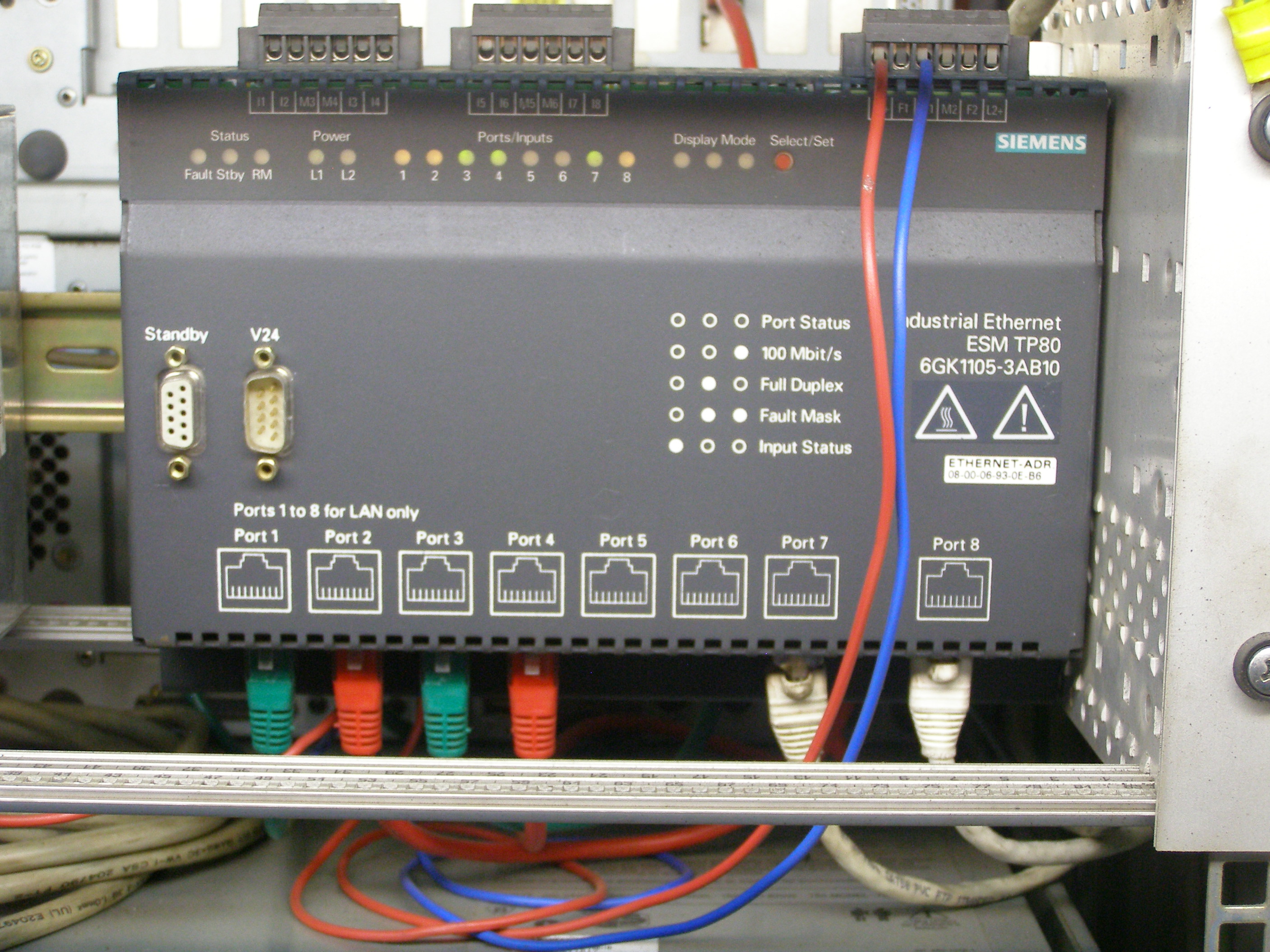
Industrial Ethernet switch:
Application environment
- Industrial plant use requires consideration of the environment in which the equipment must operate. Plant-floor equipment must tolerate a wider range of temperature, vibration, and electrical noise than equipment installed in dedicated information-technology areas.
- Industrial Ethernet networks must interoperate with both current and legacy systems, and must provide predictable performance and maintainability.
- Industrial networks often use network switches to segment a large system into logical sub-networks, divided by address, protocol, or application. Using network switches allows the network to be broken up into many small collision domains.
Advantages and difficulties
PLC (Programmable logic controller) communicate using one of several possible open or proprietary protocols, such as EtherNet/IP, Modbus, Sinec H1, Profibus, CANopen, DeviceNet or FOUNDATION Fieldbus. The idea to use standard Ethernet makes these systems more inter-operable.
Some of the advantages over other types of industrial network are:
- Increased speed, up from 9.6 kbit/s with RS-232 to 1 Gbit/s with Gigabit Ethernet over Cat5e/Cat6 cables or optical fiber
- Increased distance
- Ability to use standard access points, routers, switches, hubs, cables and optical fiber
- Ability to have more than two nodes on link, which was possible with RS-485 but not with RS-232
- Peer-to-peer architectures may replace master-slave ones
- Better interoperability
Difficulties of using Industrial Ethernet include:
- Migrating existing systems to a new protocol
- Real-time uses may suffer for protocols using TCP
- Managing a whole TCP/IP stack is more complex than just receiving serial data
- The minimum Ethernet frame size is 64 bytes, while typical industrial communication data sizes can be closer to 1–8 bytes. This protocol overhead affects data transmission efficiency.
tags:wikipedia