Comparison of synchronous and asynchronous signalling
[toc]
Synchronous and asynchronous transmissions are two different methods of transmission synchronization. Synchronous transmissions are synchronized by an external clock, while asynchronous transmissions are synchronized by special signals along the transmission medium.
lmz: 原来异步传输是广义上的同步传输!
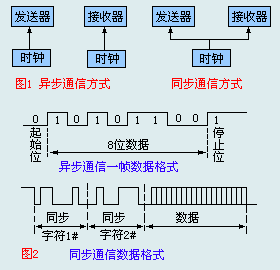
Asynchronous start-stop transmission uses start and stop bits to signify the beginning bit[citation needed] ASCII character would actually be transmitted using 10 bits. For example, "0100 0001" would become "1 0100 0001 0". The extra one (or zero, depending on parity bit) at the start and end of the transmission tells the receiver first that a character is coming and secondly that the character has ended. This method of transmission is used when data are sent intermittently as opposed to in a solid stream. In the previous example the start and stop bits are in bold. The start and stop bits must be of opposite polarity.[citation needed] This allows the receiver to recognize when the second packet of information is being sent.
Synchronous transmission uses no start and stop bits, but instead synchronizes transmission speeds at both the receiving and sending end of the transmission using clock signal(s) built into each component.[vague] A continual stream of data is then sent between the two nodes. Due to there being no start and stop bits the data transfer rate is quicker although more errors will occur, as the clocks will eventually get out of sync, and the receiving device would have the wrong time that had been agreed in the protocol for sending/receiving data, so some bytes could become corrupted (by losing bits).[citation needed] Ways to get around this problem include re-synchronization of the clocks and use of check digits to ensure the byte is correctly interpreted and received.
The need for synchronization
Whenever an electronic device transmits digital (and sometimes analogue) data to another, there must be a certain rhythm established between the two devices, i.e., the receiving device must have some way of, within the context of the fluctuating signal that it's receiving, determining where each unit of data begins and where it ends.
Methods of synchronization
- There are two ways to synchronize the two ends of the communication.
- The synchronous signalling methods use two different signals. A pulse on one signal indicates when another bit of information is ready on the other signal.
- The asynchronous signalling methods use only one signal. The receiver uses transitions on that signal to figure out the transmitter bit rate ("autobaud") and timing, and set a local clock to the proper timing, typically using a phase-locked loop (PLL) to synchronize with the transmission rate. A pulse from the local clock indicates when another bit is ready.
Advantages and disadvantages
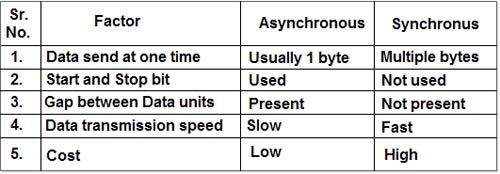
lmz: 同步通信每次传送的数据包含好几个字节,而异步通信每次只有一个字节。 同步通信没有信息要传输时要填上空字符,因为同步通信不允许有间隙。
Asynchronous transmission
Advantages:
- Simple, doesn't require synchronization of both communication sides
- Cheap, because asynchronous transmission requires less hardware
- Setup is faster than other transmissions, so well suited for applications where messages are generated at irregular intervals, for example data entry from the keyboard, and the speed depends on different applications.
Disadvantages:
- Large relative overhead, a high proportion of the transmitted bits are uniquely for control purposes and thus carry no useful information
Synchronous transmission
Advantages:
- Lower overhead and thus, greater throughput
Disadvantages:
- Slightly more complex
- Hardware is more expensive
 tags:wikipedia