Fieldbus
[toc]
Fieldbus is the name of a family of industrial computer network protocols used for real-time distributed control, standardized as IEC 61158.
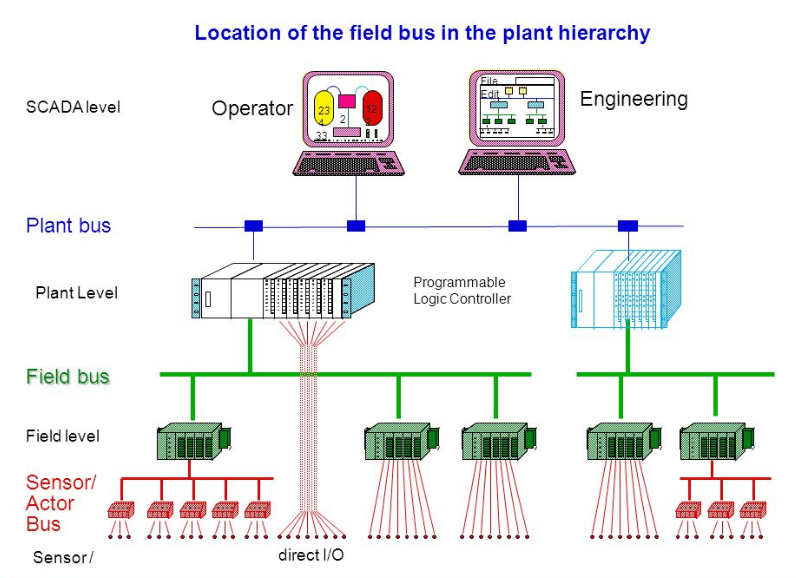
A complex automated industrial system — such as manufacturing assembly line — usually needs a distributed control system—an organized hierarchy of controller systems—to function.
- In this hierarchy, there is usually a Human Machine Interface (HMI) at the top, where an operator can monitor or operate the system.
- This is typically linked to a middle layer of programmable logic controllers (PLC) via a non-time-critical communications system (e.g. Ethernet).
- At the bottom of the control chain is the fieldbus that links the PLCs to the components that actually do the work, such as sensors, actuators, electric motors, console lights, switches, valves and contactors.
lmz:
- 工业上的分布式控制系统分为三个层级:scada(Supervisory control and data acquisition) level、plant level、field level。三个level就需要两个互联网络系统。
- scada level和plant level之间需要的是非实时的网络系统,比如以太网,连接的是主机和控制器。
- plant level和field level之间需要的是实时的网络系统,比如各种总线系统,连接的是控制器和传感器、制动器、马达等。
- 这些深入一线工作的传感器发送的信号的特点一般是
- 周期性
- 数据量小

Description
- Fieldbus is an industrial network system for real-time distributed control. It is a way to connect instruments in a manufacturing plant.
- Fieldbus works on a network structure which typically allows daisy-chain, star, ring, branch, and tree network topologies.(lmz:区分field bus和这里的拓扑)
- Previously, computers were connected using RS-232 (serial connections) by which only two devices could communicate. This would be the equivalent of the currently used 4-20 mA communication scheme which requires that each device have its own communication point at the controller level,
- while the fieldbus is the equivalent of the current LAN-type connections, which require only one communication point at the controller level and allow multiple (hundreds) of analog and digital points to be connected at the same time.
- This reduces both the length of the cable required and the number of cables required. Furthermore, since devices that communicate through fieldbus require a microprocessor, multiple points are typically provided by the same device.
- Some fieldbus devices now support control schemes such as PID control on the device side instead of forcing the controller to do the processing.
Standards
There are a wide variety of competing fieldbus standards. Some of the most widely used ones include:
- CAN
- EtherCAT
- FOUNDATION fieldbus
- Profibus
- BITBUS
Cost advantage
- The amount of cabling required is much lower in Fieldbus than in 4-20 mA installations. This is because many devices share the same set of cables in a multi-dropped(lmz:A multidrop bus (MDB) is a computer bus in which all components are connected to the electrical circuit. A process of arbitration determines which device sends information at any point. The other devices listen for the data they are intended to receive.) fashion rather than requiring a dedicated set of cables per device as in the case of 4-20 mA devices.
- Moreover, several parameters can be communicated per device in a Fieldbus network whereas only one parameter can be transmitted on a 4-20 mA connection.
- Fieldbus also provides a good foundation for the creation of a predictive and proactive maintenance strategy. The diagnostics available from fieldbus devices can be used to address issues with devices before they become critical problems.[4]
Networking
- With reference to the OSI model, fieldbus standards are determined by the physical media of the cabling, and layers one, two and seven of the reference model.
- For each technology the physical medium and the physical layer standards fully describe, in detail, the implementation of bit timing, synchronization, encoding/decoding, band rate, bus length and the physical connection of the transceiver to the communication wires.
- The data link layer standard is responsible for fully specifying how messages are assembled ready for transmission by the physical layer, error handling, message-filtering and bus arbitration and how these standards are to be implemented in hardware.
- The application layer standard, in general defines how the data communication layers are interfaced to the application that wishes to communicate. It describes message specifications, network management implementations and response to the request from the application of services. Layers three to six are not described in fieldbus standards.[6]
Ethernet and Fieldbus
Recently a number of Ethernet-based industrial communication systems have been established, most of them with extensions for real-time communication. These have the potential to replace the traditional fieldbuses in the long term.
Here is a partial list of the new Ethernet-based industrial communication systems:
| AFDX | EtherCAT | EtherNet/IP |
|---|---|---|
| Ethernet Powerlink | FOUNDATION HSE | BACnet |
| PROFINET IO | PROFINET IRT | SafetyNET p |
| SERCOS III | TTEthernet | RAPIEnet |
tags:wikipedia